Lower Your Energy Bill
Most homes waste 20–30% of the energy they pay for. Here's how to find where your money is going and stop it — ranked by dollars saved.
Start here
Why Is My Electric Bill So High? 14 Causes Ranked by Cost
Split the change into three parts before blaming an appliance: kWh used per day, the price you paid per kWh, and how many days the bill covers. If use is up, the first places to look are heating and cooling, water heating and always-on loads; if the rate or the number of days moved, no appliance is at fault.
Read the guideRun the numbers
All guides in Energy Savings
What Temperature Should You Set Your Thermostat?
The Department of Energy suggests around 68°F in winter while you're awake, and setting it lower while asleep or out. In summer, set it as high as is comfortable. The setback — the gap between occupied and unoccupied temperatures — saves more than any single number.
How Much Does It Cost to Run a Space Heater?
Cost = kilowatts × hours × your rate. A 1,500W heater is 1.5 kW, so eight hours is 12 kWh — about $2.21 a day or $66 a month at the current U.S. average of 18.44¢/kWh. That is the ceiling, not the answer: a heater with a working thermostat cycles off once the room is warm, and at a 40% duty cycle the same eight hours costs closer to $27 a month. A plug-in meter left in place for a few days is the only way to know which figure is yours.
Attic Insulation: How Much R-Value You Need and What It Saves
It depends on your climate zone. ENERGY STAR's retrofit guidance puts an uninsulated attic at R-30 in zone 1, R-49 in zones 2 and 3, and R-60 from zone 4 north. If you already have 3 to 4 inches, the target for what you add is R-25 to R-49 on the same scale. The quickest check: if you can see the tops of the ceiling joists, you are below current recommendations almost anywhere in the country.
How to Find and Seal Air Leaks in Your Home
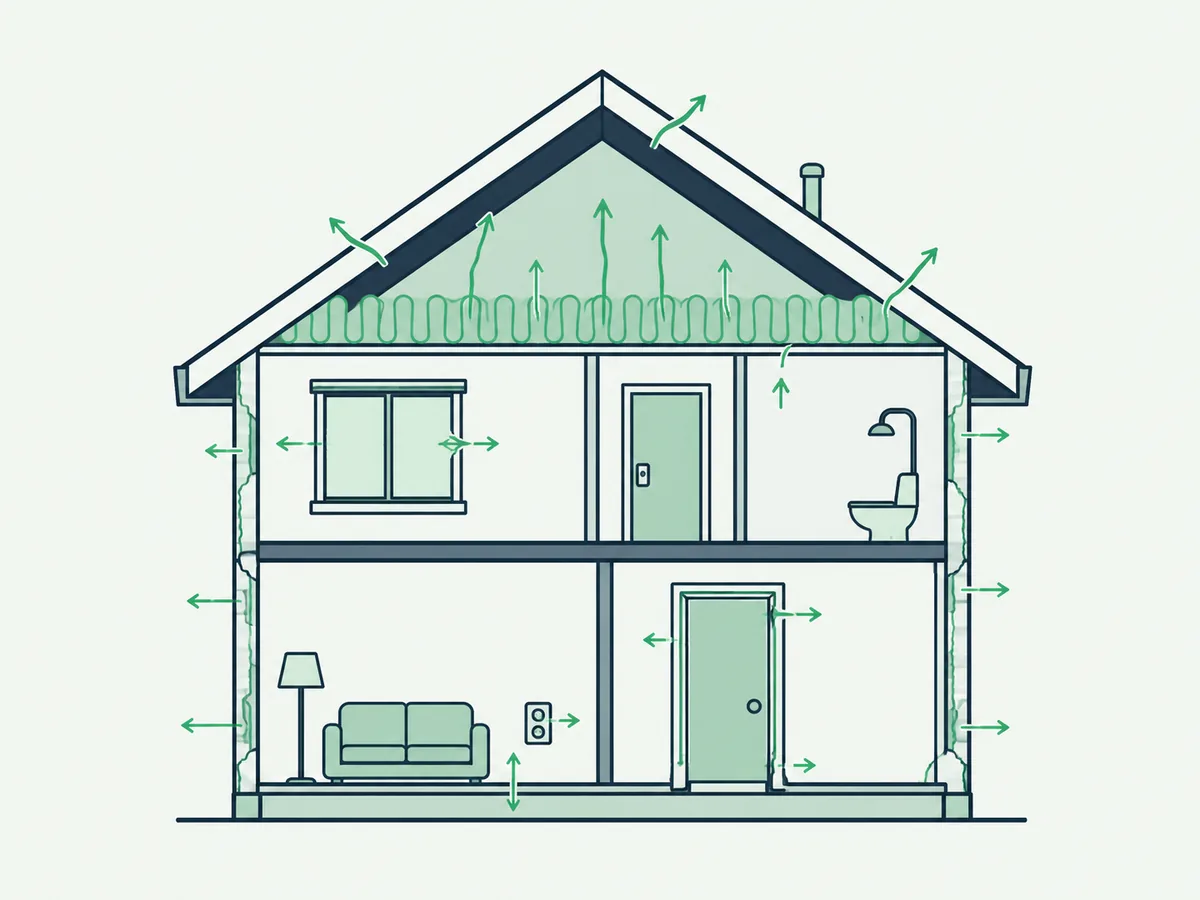
Most leaks aren't around windows — they're at the top and bottom of the house: attic hatches, recessed lights, plumbing and wiring penetrations, rim joists, and the sill plate. Work in three levels: look first, then run a simple pressure test with the combustion appliances off, and bring in a blower door when you want a number rather than an impression. Seal the top and bottom before you touch a window.
What Temperature Should Your Water Heater Be Set To?
The Department of Energy points most households to 120°F and estimates that turning the temperature down to 120°F saves somewhere between $36 and $61 a year. Two things stop that from being universal advice: a dishwasher without a booster heater may need hotter water, and public-health guidance for managed building water systems may use higher storage temperatures as part of a broader Legionella control plan. That guidance is not a universal setting for every home. What you actually save depends on where your setting starts, how much hot water you use, and your local rate.
How Much Does It Cost to Charge an EV at Home?
Home charging costs your electricity rate multiplied by how much electricity the car uses. Using the efficiency figure DOE uses in its own example — 27 kWh per 100 miles — and the U.S. average residential rate of 18.44¢/kWh, that is about $4.98 per 100 miles, or roughly 5¢ a mile. Twelve thousand miles a year comes to about $597. The same miles in a 30 mpg gasoline car at $4.10 a gallon cost about $1,638. Your own answer is decided almost entirely by your electricity rate, which ranges from 12.35¢ to 52.00¢ per kWh depending on the state.
How Much Electricity Does a Clothes Dryer Use?
Multiply the energy one cycle uses in kWh by your electricity rate. To earn ENERGY STAR, a standard-size electric dryer has to deliver at least 3.93 pounds of laundry per kWh on DOE's test load of 8.45 pounds — about 2.15 kWh for that test cycle. Real loads are usually wetter and heavier, so 3 kWh a cycle is a reasonable illustrative figure. At the U.S. average rate of 18.44¢/kWh that is roughly 55¢ a load, or about $144 a year at five loads a week. Nameplate watts are not the answer: the heating element cycles on and off, so rated watts multiplied by cycle time overstates real use. Most electric dryers run on 240 volts, which is why a standard plug-in watt meter cannot measure one.
How Much Electricity Does a Refrigerator Use?
Start from the annual kWh figure on the EnergyGuide label, not from the watts on the nameplate. The compressor cycles on and off, so multiplying rated watts by 24 hours overstates real use. At the U.S. average residential rate of 18.44¢/kWh, 500 kWh a year works out to about $92 a year, $7.68 a month, or 25¢ a day. ENERGY STAR reports that refrigerators over 15 years old could be costing about $95 a year to run, and that an old unit uses about 20% more energy than a certified one. Age, size, ambient temperature and location move the answer a long way, so measure over several days if you want a figure for your own machine.
How Much Does a Dehumidifier Cost to Run?
At the U.S. average residential rate of 18.44¢/kWh, a 500-watt dehumidifier costs about 9.2¢ an hour, 74¢ over an eight-hour day, or $2.21 if it runs a full 24 hours. The arithmetic is watts ÷ 1,000 × hours × your rate. What makes the monthly total swing is not the nameplate but the run hours: a humidistat cycles the compressor on and off, so a unit plugged in for 24 hours rarely draws power for 24 hours. Measure your own rate off your bill and count real run hours, not hours plugged in.
How to Read Your Electric Bill
Work through it in this order: the billing period and how many days it covers, the kWh used, then the charges split into supply and delivery. Divide the total amount due by the kWh used and you get the rate you actually paid, which is almost always higher than the per-kWh rate printed on the bill, because fixed charges and taxes ride on top. When two bills differ, compare kWh per day rather than dollars — a longer billing period alone can raise a total while your daily usage falls.
How we build these numbers
How we frame itCostSavingsPaybackConfidenceNext step
Every figure in this section is a modelled estimate from public data, printed with the assumptions and sources behind it. Read how we build and check these numbers