What Temperature Should Your Water Heater Be Set To?
The Department of Energy points most homes to 120°F. What lowering the setting is estimated to save, when 120°F is wrong, and how to check yours safely.
- DOE points most households to 120°F, estimating turning the temperature down saves $36 to $61 a year versus a hotter setting.
- A dishwasher without a booster heater may need hotter water — check the manual before lowering the tank.
- Public-health guidance for large managed building water systems may use higher storage temperatures for Legionella control — that isn't a universal setting for a single-home tank.
- Scalding risk rises fast with temperature; a thermostatic mixing valve lets you store hot while delivering cooler water at the tap.
- Never open an electric water heater's compartment yourself — it's a live 240-volt space, a job for an electrician or plumber.
On this page
Most water heaters leave the factory hotter than the household needs, and most people never touch the dial. Turning it down is one of the few energy changes that costs nothing and takes five minutes. It is also one where the wrong answer has consequences that are not financial, which is why this guide spends as much time on the exceptions as on the saving.
What temperature should a water heater be set to?
DOE points most households to 120°F. The reasoning is a trade-off rather than a safety rule: the hotter the tank, the more heat escapes through its walls while nobody is using hot water, and the more energy goes into every gallon that is used. Below a certain point you stop having enough hot water; above it you are paying to store heat you never draw.
Two things confuse this. First, the number on the dial is a target, not a measurement — actual delivered temperature depends on the thermostat's accuracy, the distance to the tap, and any mixing valve in between. Second, storage temperature and tap temperature are different questions, and the health guidance discussed later applies to storage rather than to what comes out of the faucet.
What lowering the temperature can save
DOE estimates that turning the temperature down to 120°F saves between $36 and $61 a year. That range is doing two jobs at once: cutting standby losses, which DOE puts at 10% to 20% of annual water heating costs, and reducing the energy in each gallon delivered.
For scale, DOE describes water heating as the second largest energy expense in a typical home, at roughly 18% of the utility bill. That makes it a worthwhile target, and it also sets a ceiling on what any single adjustment can achieve.
120°F vs 140°F: the practical trade-offs
Neither setting is right in the abstract. The table below is a summary of the trade-off, not a recommendation for your household.
| Setting | Energy | Scald risk | Hygiene notes | Best fit |
|---|---|---|---|---|
| 120°F | Lowest standby loss | Lower | Warm enough for bacteria to grow in water systems generally | Most households; small children or older adults at home |
| 130°F | Middle | Moderate | Growth becomes less favored as temperature rises | A compromise where hot water runs short at 120°F |
| 140°F | Highest standby loss | Higher — burns occur fast | Nearer the storage temperatures used in building control programs | Dishwasher without a booster; specific medical advice |
How to check your current setting
- Look for a digital display first. Many newer gas and heat pump units show the setpoint directly, and some let you read it without opening anything.
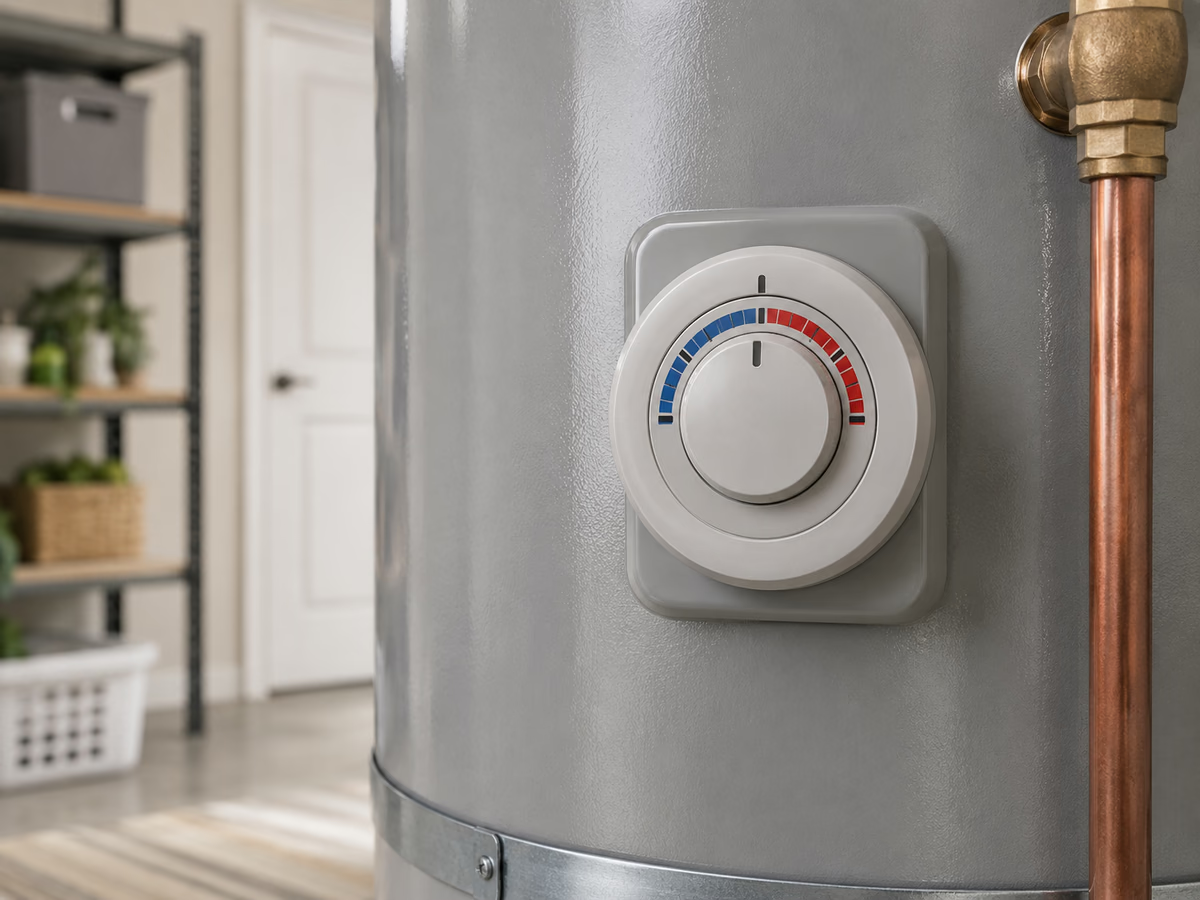
- On an older gas unit, the dial sits on the gas control valve near the bottom. It is often marked with words — warm, hot, very hot — rather than numbers.
- Do not open the access panel of an electric tank to look for the dial. Its thermostats sit behind a cover in a live 240-volt compartment.
- Measure instead of guessing: run the hot tap nearest the heater for a couple of minutes, fill a cup, and read it with a kitchen thermometer.
- Take the reading again at a distant tap. A large gap between the two points to heat lost in long runs of uninsulated pipe, not to a wrong setting.
- If the measured temperature and the dial disagree, trust the thermometer.
How to adjust the temperature safely
Gas tank water heaters
The dial on the gas control valve is designed to be turned by hand and is the one adjustment most homeowners can safely make. Turn it in small increments, wait several hours, and measure again. Do not remove the valve, disturb the gas line, or relight a pilot you are not confident about — that is a call to the gas utility or a licensed plumber.
Electric tank water heaters
Most electric tanks have two thermostats behind screwed access panels, and both normally have to be set to the same temperature. The compartment carries 240 volts. Unless you are confident about isolating the circuit at the breaker and verifying it is dead, this is a job for an electrician or a plumber — the saving does not justify the risk, and a mismatched pair of thermostats can leave you with less hot water rather than more.
Tankless water heaters
These heat water as it flows and store almost nothing, so the standby-loss half of the argument largely disappears. The setpoint is usually adjustable from a front panel or a remote controller. Lowering it still cuts the energy in each gallon, but expect a smaller change than on a storage tank, and follow the manufacturer's instructions rather than a general rule.
When 120°F may not be the right setting
The energy advice and the microbiological guidance point in different directions, and it is more useful to say so plainly than to pick one.
Legionella grows in warm water, and public-health guidance for managed building water systems may use higher storage temperatures as part of a broader Legionella control plan. That guidance is not a universal setting for every home: it is written for water management programs in hospitals, hotels and large properties with recirculating loops, where the system holds far more water and moves it much further than a single tank does.
This is also why many units leave the factory at 140°F: some equipment specifications set that temperature partly to limit bacterial growth. So the choice in front of you is not a manufacturer's oversight to correct — it is a genuine trade-off that the factory resolved one way and DOE's energy guidance resolves another.
There is some evidence that the distinction matters. A study published in CDC's Emerging Infectious Diseases journal in 2004 found independent household water heaters largely free of Legionella, while centralized systems serving whole buildings and neighborhoods showed higher colonization. It identified a central heating system, distance of more than 10 metres from the heating point, and a system more than ten years old as factors each independently associated with higher colonization. That study set out no recommended temperature for a home water heater, and neither do we.
- Someone in the household is immunocompromised, has chronic lung disease, or has been given specific advice by a clinician. This is a medical question first and an energy question second.
- The dishwasher has no internal booster heater. DOE describes 140°F as the temperature recommended for cleaning and notes that a booster raises incoming water to that level inside the machine. Check the manual before lowering the tank.
- Long, uninsulated pipe runs mean water arrives at distant taps much cooler than it leaves the tank. Insulating the first few feet of pipe often fixes this better than raising the setting.
- The tank is undersized for the household and runs out during back-to-back showers. Raising the temperature is a workaround; it stores more usable heat but does not solve the sizing problem.
- A shared or building-wide system, where the setting is not yours to change.
- The water is not hot enough even at a correct setting, which usually indicates a failing heating element, a stuck thermostat, or heavy sediment — a diagnosis, not a dial adjustment.
Other ways to reduce water-heating costs
- Use less hot water. It is the largest lever available and DOE lists it first — shorter showers and cold-water laundry move more than the dial does.
- Fix dripping hot taps. A slow drip on the hot side is water you paid to heat, running to the drain around the clock.
- Fit low-flow showerheads and aerators, which cut hot water volume without a noticeable change in the shower.
- Insulate the first few feet of pipe leaving the tank, where it is accessible and away from the flue on gas units.
- Use the vacation or away setting before a long absence, if the unit has one, rather than leaving a full tank hot for an empty house.
- When the tank eventually fails, that is the moment to compare technologies rather than replace like for like in an emergency.
What to do next
- If your water feels too hot: measure it at the tap, and if it reads well above 120°F, lower the setting in small steps and re-measure after a few hours.
- If your bill is high but the temperature is normal: this is not your problem. Water heating is around 18% of the bill and this adjustment moves a few percent of that, so look at heating, cooling and the largest appliances instead.
- If the water is not hot enough, or someone in the household has a medical reason to want it hotter: leave the setting alone and get a plumber to look at the system, a mixing valve, or both — and take the medical question to a clinician.
Sources
- Reduce Hot Water Use for Energy Savings (120°F setting and savings range) — U.S. Department of Energy — Energy Saver. Consulted August 2, 2026.
- Water Heating (share of the utility bill, standby losses, ways to cut cost) — U.S. Department of Energy — Energy Saver. Consulted August 2, 2026.
- Controlling Legionella in Potable Water Systems (control guidance for building water systems) — U.S. Centers for Disease Control and Prevention. Consulted August 2, 2026.
- Legionella Infection Risk from Domestic Hot Water (Emerging Infectious Diseases, vol. 10 no. 3, March 2004) — U.S. Centers for Disease Control and Prevention. Consulted August 2, 2026.
- Heat Pump Water Heaters — U.S. Department of Energy — Energy Saver. Consulted July 22, 2026.
- Electric Power Monthly, Table 5.6.A — average residential price by state — U.S. Energy Information Administration. Consulted August 1, 2026.
Frequently asked questions
Is 120°F hot enough for a water heater?
For most households, yes — it is the setting DOE points to, and it delivers water hot enough for showers, laundry and hand washing. The two common exceptions are a dishwasher with no internal booster heater, and a household where someone's doctor has advised otherwise.
Is 140°F too hot?
It is hotter than most households need and it costs more to maintain, both through standby losses and through the extra energy in every gallon. It also raises scalding risk noticeably, which matters most with young children, older adults, and anyone with reduced heat sensitivity. Some homes still run it deliberately, and the trade-offs section explains why.
Can lowering the temperature cause Legionella?
Legionella grows in warm water, and public-health guidance for managed building water systems may use higher storage temperatures as part of a broader Legionella control plan. That guidance is not a universal setting for every home. A study published in CDC's Emerging Infectious Diseases journal found independent household water heaters largely free of contamination while centralized building and neighborhood systems showed higher colonization — the risk concentrates in large shared systems rather than in a single tank. If someone in your household is immunocompromised or has chronic lung disease, take the question to their doctor and a licensed plumber rather than to an energy article.
How much does lowering the water heater temperature save?
DOE estimates $36 to $61 a year for turning the temperature down to 120°F. Treat that as an order of magnitude. It is a national estimate tied to a specific change, not a percentage you can apply to your own bill.
Does a dishwasher need 140°F water?
DOE describes 140°F as the temperature recommended for cleaning, and notes that a booster heater raises incoming water to that level inside the machine. Most modern dishwashers have one. If yours does not, check the manual before lowering the tank — DOE notes that dishwashers with booster heaters typically pay for themselves in about a year when you also lower the water heater setting.
How long does a temperature change take to show up?
A full tank has to cycle through before the new setting is reflected at the tap. Give it several hours to a day of normal use, then measure again at the same faucet rather than judging by feel.