Heat Pump Water Heater vs Standard Electric: What You Actually Save
Why a heat pump water heater uses far less electricity than a standard tank, what it costs upfront, and the installation conditions that decide whether it works in your home.
- ENERGY STAR estimates about $550 a year saved versus a standard electric tank for a household of four, at a stated 14.6¢/kWh rate.
- The incremental purchase cost is about $1,503 — roughly a three-year payback before any rebate.
- Installation is the real catch: the unit needs about 700 cubic feet of surrounding air, a condensate drain, a 240-volt supply, and space above roughly 40°F.
- In a warm humid basement the cooling/drying side effect is a bonus; in a cold basement it can steal heat your furnace just paid for.
- The federal 25C credit that used to offset this purchase ended for property placed in service after December 31, 2025.
On this page
Water heating is one of the largest loads in a typical home, and it's the one people replace reactively — usually the week the old tank fails. That's the worst possible moment to compare technologies, because the only question that gets asked is what can be delivered tomorrow. Here is the comparison worth having beforehand.
Why the efficiency gap is so large
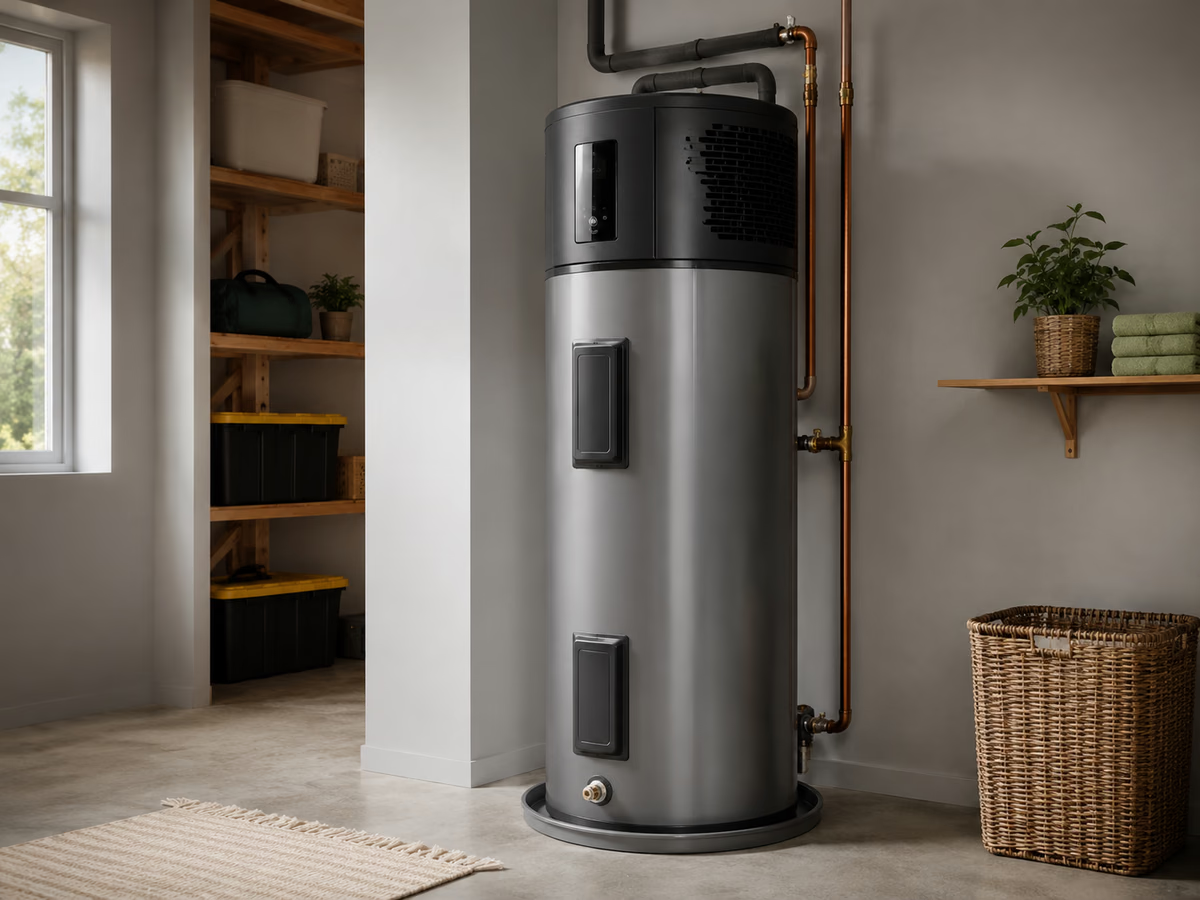
A standard electric tank turns electricity into heat with a resistance element: one unit of electricity in, one unit of heat out, and no way to do better. A heat pump water heater runs a refrigeration cycle in reverse, pulling warmth out of the surrounding air and moving it into the tank. Because it moves heat rather than creating it, it delivers several units of heat per unit of electricity — ENERGY STAR puts certified models at roughly 70% less energy than a standard electric tank.
What it costs to buy and install
This is where the audit of your own basement matters more than the spec sheet. ENERGY STAR's own guidance is blunt that installation can cost roughly as much as the unit.
| Cost item | Typical range or driver | When it applies |
|---|---|---|
| The unit itself | $1,500 – $3,000 before incentives | Always; split-unit models cost considerably more |
| Labor and materials | $1,000 – $3,000 | Always; varies with local plumbing and HVAC rates |
| Electrical work | Added cost | A 240-volt supply is required; replacing a gas unit may mean a breaker box upgrade or a dedicated conduit run |
| Condensate management | Added cost | The unit produces water as it runs and it has to drain somewhere |
| Carpentry or venting | Added cost | A louvered door or a venting kit where the space is too confined |
| Sound reduction kit | Optional | Where the unit sits near living or sleeping space |
| Utility or state rebate | Typically −$300 to −$1,000 | Where your utility runs a program |
What it costs to run
ENERGY STAR publishes the saving rather than the two running costs, but it also publishes the assumptions behind it, which lets us reconstruct both sides transparently. Here is that arithmetic in full.
The installation conditions that decide it
| Requirement | What it means | Why it matters |
|---|---|---|
| Air volume | About 700 cubic feet around the unit — roughly a 10×10 room with a 7-foot ceiling | It extracts heat from room air; ENERGY STAR warns efficiency suffers in confined spaces like closets |
| Ambient temperature | Above roughly 40°F year-round | Below its operating range the unit falls back on resistance elements and the saving disappears |
| Condensate drain | A floor drain, condensate pump, or gravity route | It dehumidifies as it runs and produces water continuously |
| 240-volt supply | An existing circuit, or new work from the panel | Required; replacing a gas unit almost always means new electrical work |
| Noise tolerance | Compressor and fan, audible in the room | Matters if the space adjoins living or sleeping areas |
| Physical height | Usually taller than the tank it replaces | Measure the ceiling clearance before ordering, not after delivery |
Where a heat pump water heater is the wrong choice
- A sealed closet with no practical route to add a louvered door or ducting.
- An unheated garage or crawl space in a northern climate, where the unit spends the winter below its operating range on resistance backup.
- A tank located against a bedroom wall in a household sensitive to noise.
- A house where the electrical panel has no capacity and upgrading it would dominate the project cost.
- An emergency replacement with no time to assess any of the above — in which case a like-for-like swap now and a planned upgrade later is a defensible choice.
Incentives in 2026
The federal Energy Efficient Home Improvement Credit (Section 25C), which covered this equipment, ended for property placed in service after 31 December 2025. Be aware that some manufacturer and even ENERGY STAR pages still describe that credit as available; the IRS position is the one that governs. What remains is state and utility programs, and ENERGY STAR notes those typically run in the $300 to $1,000 range where they exist.
What to do next
Do the space check before you shop: air volume, ceiling height, drain, circuit, winter temperature. Those five answers decide whether this is a straightforward swap or a project, and they are what separates a $2,500 job from a $6,000 one. Then compare quotes on installed cost with the rebate applied, not on the sticker price of the tank.
Sources
- Save More with ENERGY STAR Certified Heat Pump Water Heaters (savings and stated assumptions) — U.S. EPA / DOE — ENERGY STAR. Consulted August 1, 2026.
- What Goes into the Cost of Installing a Heat Pump Water Heater? — U.S. EPA / DOE — ENERGY STAR. Consulted August 1, 2026.
- Is a Heat Pump Water Heater Right for Your Home? (air volume and placement) — U.S. EPA / DOE — ENERGY STAR. Consulted August 1, 2026.
- Heat Pump Water Heaters — U.S. Department of Energy — Energy Saver. Consulted July 22, 2026.
- Energy Efficient Home Improvement Credit — Internal Revenue Service. Consulted July 22, 2026.
- Electric Power Monthly (residential electricity prices) — U.S. Energy Information Administration. Consulted July 22, 2026.
Frequently asked questions
How much less electricity does a heat pump water heater use?
ENERGY STAR states that certified heat pump water heaters use about 70% less energy than a standard electric water heater, because they move ambient heat into the water instead of generating it with a resistance element.
How much does one actually save per year?
ENERGY STAR estimates about $550 a year for a household of four against a standard electric tank, and more than $5,610 over the unit's life. Those figures assume 14.6¢/kWh, an incremental purchase cost of $1,503 and a 13-year lifespan — change any of those and the answer changes.
What does it cost to buy and install?
ENERGY STAR puts the unit itself at roughly $1,500 to $3,000 before incentives, and labor and materials at another $1,000 to $3,000 — noting that installation can cost about as much as the water heater. What pushes it to the top of that range is electrical work, condensate drainage, and carpentry such as a louvered door.
Do they need a lot of space?
Yes. ENERGY STAR recommends placing one where it has about 700 cubic feet of surrounding air — roughly a 10-by-10-foot utility room with a 7-foot ceiling — and warns that efficiency suffers in confined spaces like closets. A sealed closet needs ducting or a louvered door.
Are they noisy, and do they cool the room?
Both, and for the same reason: the unit runs a compressor and a fan, and it works by pulling heat out of the surrounding air. Expect something closer to a dehumidifier than a silent tank, and expect the space around it to end up cooler and drier.