How Many Solar Panels Do You Need?
How to estimate the number of solar panels your home needs, starting from your annual kWh — including the system losses that most quick calculations leave out.
- Panels needed ≈ your annual kWh ÷ what one panel produces in a year.
- A panel's yearly output = wattage ÷ 1,000 × local peak sun hours × 365 × (1 − system losses).
- PVWatts' default system loss assumption is 14% — skipping it is the most common sizing error.
- On typical assumptions (400W panel, 4.5 sun hours), one panel makes roughly 565 kWh a year.
- At the U.S. average of about 10,800 kWh/year, that's roughly 19 panels for a full offset — run PVWatts for your own address before acting on it.
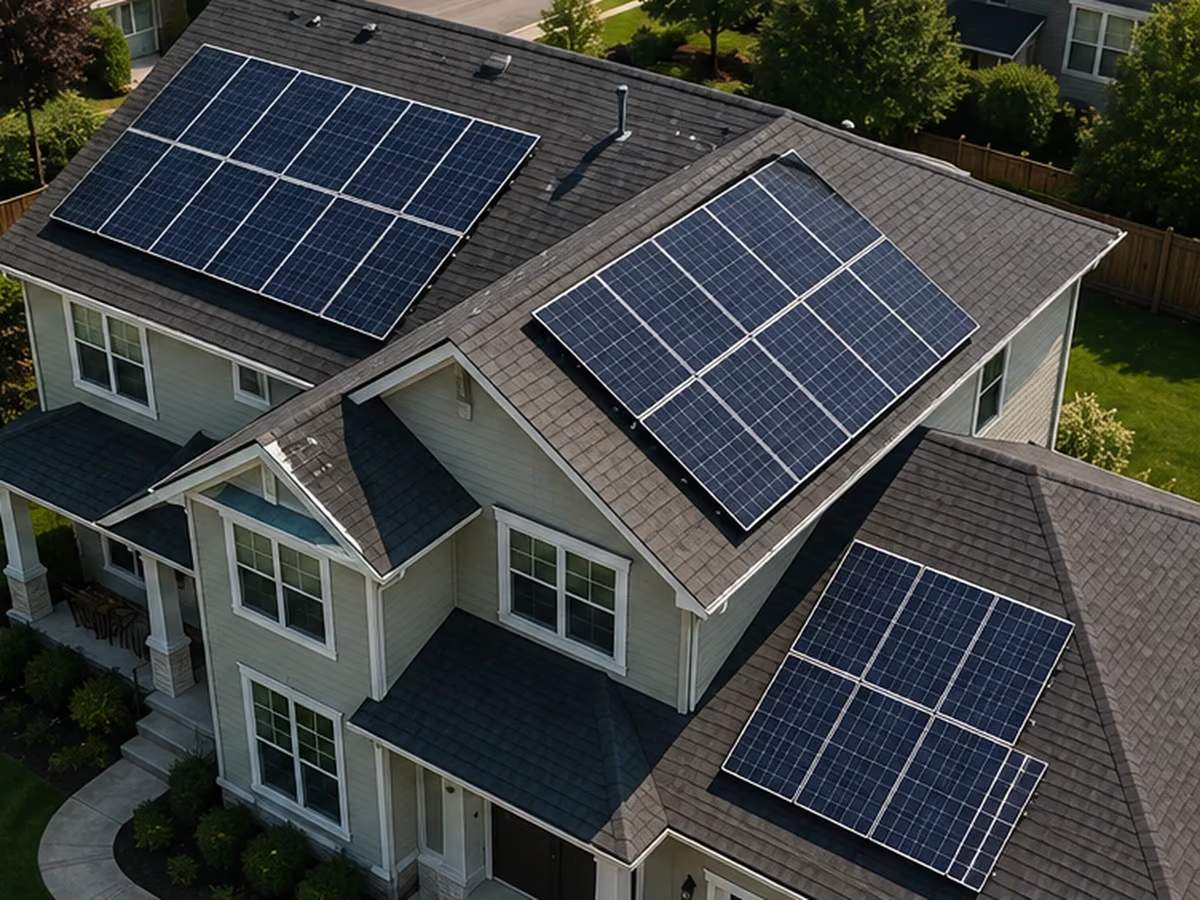
On this page
Most quick answers to this question divide annual electricity use by panel wattage and stop there. That skips the step that matters most: a panel almost never produces its rated wattage, and the gap between the label and the roof is large enough to change the panel count by several units.
The calculation in one line
Panels needed ≈ your annual kWh ÷ what one panel produces in a year. Everything else is working out that second number honestly.
Annual output per panel (kWh) = panel watts ÷ 1,000 × peak sun hours per day × 365 × (1 − system losses).
Step 1: Find your annual electricity use in kWh
Add up twelve months of bills and record the kilowatt-hours, not the dollars. Rates change and seasonal bills swing wildly, so a dollar figure tells you very little about how much energy you actually use. Most utilities show a twelve-month usage history in the online account, which saves digging through paper.
For reference, EIA reports that the average U.S. residential utility customer bought 10,791 kWh in 2022, about 899 kWh a month — but the state spread is enormous, from roughly 6,178 kWh in Hawaii to 14,774 kWh in Louisiana. Use your own number; the national average is only useful as a sanity check.
Step 2: Estimate what the sun delivers where you live
Peak sun hours express a whole year of local sunlight as an equivalent number of full-intensity hours per day. A location with 4.5 peak sun hours does not get 4.5 hours of daylight — it receives, across the year, the same total energy as 4.5 hours a day at full test intensity. The figure already bakes in your normal cloud cover, latitude and seasonal variation.
Do not take this from a national map if you can avoid it. NREL's PVWatts asks for your address and pulls the solar resource data for that location, and it lets you enter your actual roof orientation and tilt. DOE notes that panels perform best on south-facing roofs sloped between 15 and 40 degrees; the further you are from that, the more the generic figure misleads.
Step 3: Pick a realistic panel wattage
Modern residential modules commonly sit around 400W, which is the figure used below. It is a placeholder, not a standard — module wattage has climbed steadily and quotes vary. A higher-wattage panel means fewer panels for the same output, which matters when roof area rather than budget is your binding constraint. Take the wattage from the specification sheet on an actual quote rather than assuming.
Step 4: Subtract system losses
A module's wattage is measured under standardized test conditions in a lab. On a roof, several things take a share before the electricity reaches your panel board. PVWatts groups these as system losses and applies a 14% default, which is where the 0.86 factor in the example comes from.
| Loss | What it is | PVWatts default | Can you reduce it? |
|---|---|---|---|
| Shading | Obstructions blocking part of the array at some hours | 3% | Yes, at design stage — placement, tree work, module-level electronics |
| Availability | Time the system is offline for maintenance or a grid outage | 3% | Partly, through monitoring and prompt service |
| Soiling | Dust, pollen, and droppings on the glass | 2% | Partly — rain does most of it; cleaning helps in dry, dusty areas |
| Mismatch | Modules in a string never perform identically | 2% | No — inherent to the hardware |
| Wiring | Resistance in the DC and AC conductors | 2% | Marginally, through conductor sizing at design |
| Light-induced degradation | Small output drop in the first hours of exposure | 1.5% | No |
| Nameplate rating | Real module output versus its label tolerance | 1% | No |
| Connections | Losses at connectors and terminations | 0.5% | No |
| Snow | Output lost to snow cover | 0% by default | Location-dependent; tilt helps panels shed snow |
| Age | Gradual degradation over the system's life | 0% in year one | No — it accumulates each year |
Worked example
Roof space and other practical limits
The arithmetic gives you a target. Whether the roof can hold it is a separate question, and it is usually the one that decides the final design.
- Usable area is smaller than total roof area. Fire codes require clear pathways and setbacks around the array, and vents, chimneys and dormers break up what remains.
- Only some roof planes are worth using. DOE puts the sweet spot at south-facing with a 15 to 40 degree slope; east and west planes still work but produce less per panel, so you need more of them.
- Roof age matters. If the roof is near replacement, doing it before the array goes up avoids paying to remove and reinstall panels later.
- Structure has to carry the load, which DOE says should be confirmed by a solar installer, roofing expert or structural engineer.
- Inverter sizing and string layout constrain how panels can be grouped, which sometimes nudges the count up or down.
When this estimate will be wrong
- Meaningful shading. A formula applies one flat percentage; real shade hits specific panels at specific times of day and season.
- A roof that faces the wrong way, or several small planes instead of one large one.
- Heavy snow regions, where the PVWatts snow default of zero clearly does not apply.
- A household whose usage is about to change — a new EV, a heat pump, a home addition, or someone moving in or out.
- Net metering terms that make exported electricity worth much less than what you buy, which changes whether a full offset is even the right goal. DOE points out this depends entirely on your state and your utility.
- Any local rule capping system size relative to your historical usage, which some utilities apply.
What to do next
Run the arithmetic above with your own numbers, then run PVWatts for your address and compare. If the two land close together, you have a defensible starting point for a conversation with installers. If they diverge sharply, the cause is almost always shading or roof orientation — and that is precisely the thing worth resolving with a site assessment before you look at any quote.
Sources
- PVWatts Calculator (solar production modelling) — National Renewable Energy Laboratory. Consulted July 22, 2026.
- PVWatts Version 5 Manual — system loss categories and default values — National Renewable Energy Laboratory. Consulted July 31, 2026.
- How much electricity does an American home use? (annual kWh per residential customer, by state) — U.S. Energy Information Administration. Consulted July 31, 2026.
- Homeowner's Guide to Solar (roof suitability, orientation, net metering) — U.S. Department of Energy. Consulted July 31, 2026.
- Permitting and Inspection for Rooftop Solar — U.S. Department of Energy — Solar Energy Technologies Office. Consulted July 31, 2026.
Frequently asked questions
How many solar panels does an average house need?
Using the U.S. average of about 10,800 kWh a year, a 400W panel and 4.5 peak sun hours, the arithmetic lands near 19 panels for a full offset. Treat that as an order of magnitude, not a target: EIA data shows annual use per residential customer ranging from about 6,200 kWh in Hawaii to about 14,800 kWh in Louisiana, and sun hours vary just as much.
What is a system derate, and why does it matter?
A panel is rated under standardized lab conditions. In a real installation, dust, shading, wiring resistance, module mismatch and downtime all take a share of the output. The derate is the combined effect. Leaving it out is the single most common reason a back-of-envelope estimate comes in too low.
Why can't I just divide my annual kWh by my panel wattage?
Because watts and kilowatt-hours measure different things. Watts are power — the rate at a given instant. Kilowatt-hours are energy — power multiplied by time. You have to bring in hours of sunlight before the two can be compared.
Do solar panels work on cloudy days?
Yes, at reduced output. For sizing it doesn't matter much, because peak sun hour figures are derived from a year of local irradiance data and already account for the cloud cover your area normally gets.
Should I size for 100% of my usage?
Not necessarily. Roof area, budget, and your utility's net metering terms all argue for different answers, and DOE points out that whether a system qualifies for net metering depends on your state and your utility. If a heat pump or an EV is coming, size against that future figure rather than last year's bills.